
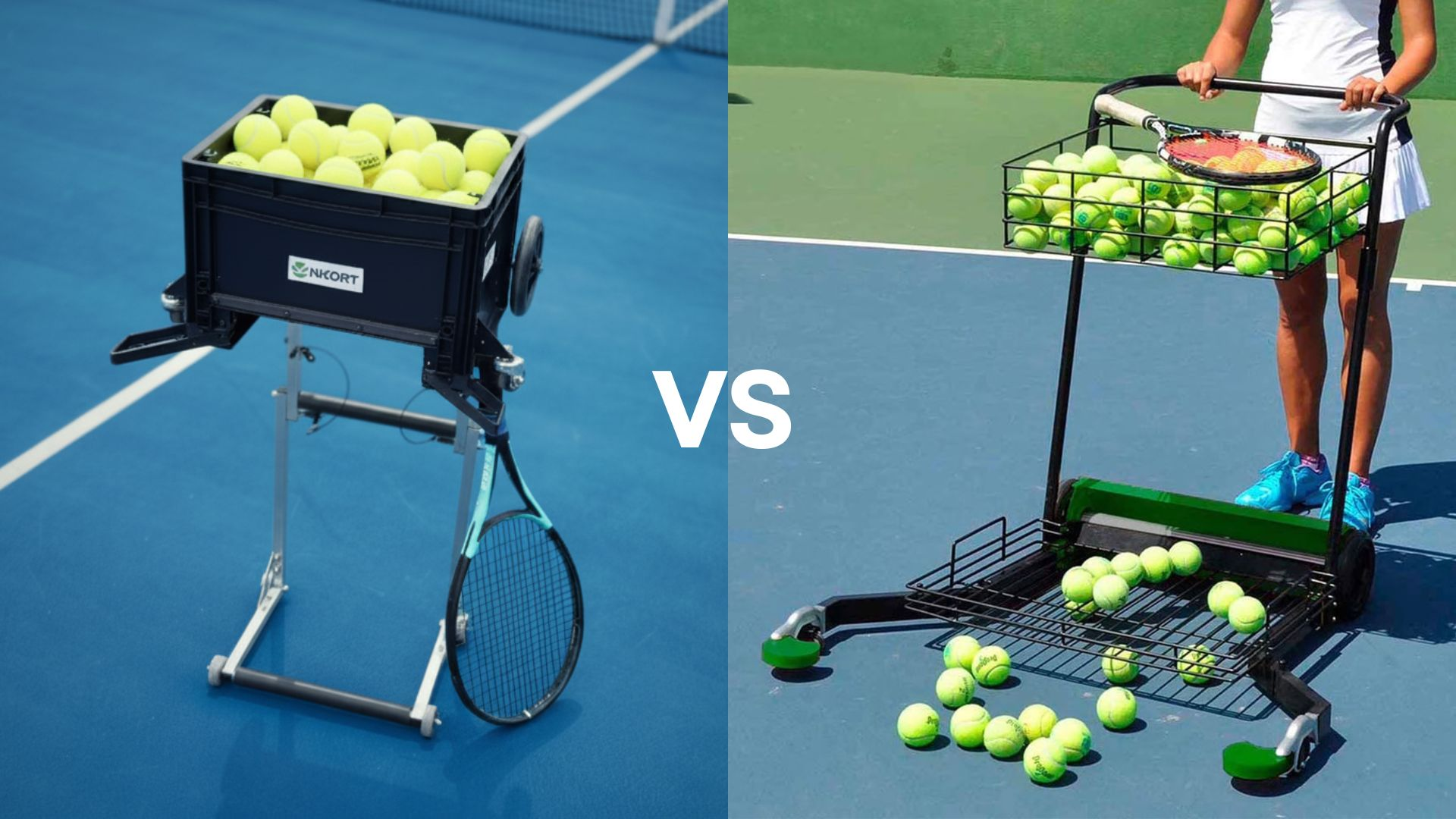
If you’ve ever spent a sweaty afternoon chasing tennis or pickleball after every shot, you know the drill: those large ball-mowers are supposed to save the day, but most of them feel like overkill, bulky beasts that eat up your garage space and your wallet. Enter FLIPP by NKORT, a clever portable ball-mower that’s shaking things up for solo players, coaches, and anyone who hates interruptions in their groove. Here is FLIPP how it stacks up against those big, club-style ball mowers you see rumbling around pro facilities. Let’s break it down.
First off, capacity. Those massive mowers at tennis clubs? They’re built like tanks, hauling 200 to 300 balls in one go. Sounds impressive, right? But here’s the rub: more balls often means longer hauls back to the court, killing your momentum during practice. With FLIPP, you’re looking at 100 tennis balls or 75 pickleballss, enough for a solid 5-6 minute rally of groundstrokes or serves without stopping. For one-on-one lessons or solo drills, that’s gold. You hit 80 reps in a row, scoop ’em up quick, and dive right back in.
Portability is where the FLIPP really shines. Those club mowers? They are designed for permanent setup on sprawling courts, not your driveway or local park. FLIPP, on the other hand, is a lightweight champ at under 10 pounds, folds down, and slips into your trunk like it’s no big deal. Grab it for a quick session at the club, then stash it away. No more wrestling with equipment that feels like it’s plotting against you.
The hero: FLIPP by NKORT
FLIPP is a dual-purpose ball picker + hopper. On the site:
- It collects up to 100 tennis balls (or ~75 pickleballss) with one sweep.
- It converts quickly from “picker” mode to “hopper” mode via a simple handle flip.
- It’s lightweight, foldable, designed for portability and easy storage.
- It works with tennis, pickleball and padel balls (multi-sport).
- It’s integrated spring-loaded forks help collect balls from the edges of the court.
Given that, at a pre-order price of around USD $299, FLIPP offers a compelling package for a lot of use cases.
The “big hitters”: Large ball-mowers
In contrast, large capacity machines (often used by clubs) go for 200-300 ball capacity or more, and cost significantly more. For example:
- The MultiMower by OnCourt OffCourt: capacity ~300 balls; list price around US $499-599 in one listing. OnCourt OffCourt
- A “120 ball capacity” collector from Vermont Sports lists at USD $399.99 for 120 balls. Vermont Sports
These machines certainly have their place: if you run large group clinics or have multiple courts going simultaneously, the ability to pick up and hold hundreds of balls means less frequent stops for collection.
Comparison table
| Feature | FLIPP by NKORT | Large Ball-Mower Systems |
|---|---|---|
| Capacity | ~100 tennis balls (or ~75 pickleballss) | ~120 up to ~300 balls common |
| Price | ~USD $299 (pre-order) | USD $400–600+ for 120–300 capacity; some higher |
| Portability / Size | Lightweight, foldable, fits trunk, easy to transport | Heavier, more bulky frame, often built for club use |
| Multi-sport compatibility | Tennis and pickleball/padel | Many built primarily for tennis; pickleball compatibility may vary |
| Practical for solo or one-on-one use | Excellent: 80 balls = ~5-6 minutes of continuous reps, minimal downtime | Capacity is high but you may rarely hit full capacity in solo/coaching; collection may still take time |
| Storage / convenience | Compact storage, minimal footprint | Requires more storage space, heavier lifting, less flexibility |
| Ideal user | Solo player, coach working 1-on-1, player who wants mobility | Tennis club, big group coaching, facility serving many players simultaneously |
Why “less capacity” might actually be a feature
- Drill rhythm matters: If you’re doing a block of 80 ground strokes or serves, you’re hitting hard, you want minimal interruption. Collecting 80 balls gives you ~5-6 minutes of play. Once you finish, you stop, refill, and go again. That’s a natural rhythm for solo practice.
- Time spent collecting is overhead: If you choose a 300-ball machine, sure you can collect more balls in one go but that also means more time walking/running to gather them, maybe more breakdown time, more storage. For solo use, often you don’t need 300 at once.
- Mobility counts: FLIPP’s portability means you can move it easily between courts, take it to tournaments, hit off-site, load it into your car. A large mower may stay fixed in the club equipment room.
- Multi-sport flexibility: With pickleball booming, having a device that works both for tennis and pickleball means better long-term flexibility.
- Cost-effectiveness: If you’re buying yourself or your small coaching business, the lower investment is easier to justify—especially if you don’t need the full capacity of a large machine.
- Storage & space: FLIPP fits in all car trunks (even small sedan trunks) and inside your closet for the off season. Try to lift and fit one of those mega mowers into your trunk!
When you might still pick a large machine
There are scenarios where the larger machines make perfect sense:
- If you’re running group clinics with many players hitting simultaneously on one court. You’ll go through hundreds of balls quickly, so capacity matters.
- If you coach multiple courts and want one device serving them all, minimizing stops.
- If you have a dedicated facility with staff, space, and heavy duty usage.
- If the cost is justified as part of your business equipment budget, and you don’t care about portability.
Final recommendation & call to action
If you are a player who practices by yourself, or a coach who works largely one-on-one (or with small groups), FLIPP by NKORT hits the sweet spot: simple, portable, multi-sport, and perfectly sized for a full high-volume drill without being overkill. The fact that you’ll often only need 80 balls in a set means you stay focused on hitting rather than chasing. At about USD $299 pre-order, it’s a smart investment.
👉 If this sounds like your use case, go ahead and pre-order FLIPP at NKORT.com/PreOrder and get your practice sessions flowing rather than stopping for ball pickup.