
You show up with good intentions: a full basket, a fresh can of balls, maybe even a new drill you saved from YouTube.
Twenty minutes later, you are doing the least glamorous part of tennis. You are chasing balls that have drifted to the fence, wedged into corners, and somehow always end up exactly where your hopper works the worst.
If you use a ball machine regularly, your “hopper” is not just storage. It is the missing link in your training loop:
Hit → balls scatter → collect fast → reload cleanly → hit again.
This guide is built around that loop. You will get:
- A practical buying checklist for ball machine users
- A fair comparison of the major categories, including Kollectaball, Tomohopper, classic baskets (Tourna/Gamma style), ball mowers, and robot collectors
- Clear “best for” picks depending on how you train
- A smart upgrade path if you plan to practice a lot in 2026
What matters most when you use a ball machine
Most “best hopper” lists obsess over capacity. Capacity matters, but ball machine users usually care more about these five things:
1) Reload speed (real-world cycle time)
It is not “how many balls it holds.” It is “how quickly you can collect 60–120 balls and get them back into the machine without breaking rhythm.”
2) Fence and corner performance
A lot of collectors are great in open court and frustrating at the fence line. If you practice hard, you will spend a disproportionate amount of time on the last 15 balls.
3) Unloading into a ball machine
This is the most overlooked feature. Some systems spill. Some require awkward shaking. Some dump too fast. A few are designed specifically to dispense neatly into a machine.
4) Ergonomics
If you reload a ball machine multiple times a week, bending becomes a training limiter, not a minor inconvenience.
5) Court compatibility and durability
Wheels, wire cages, and pickup mechanisms all behave differently on hard court vs clay vs indoor surfaces. Durability matters because ball machine reps are repetitive and unforgiving.
The main categories (and why they feel different)
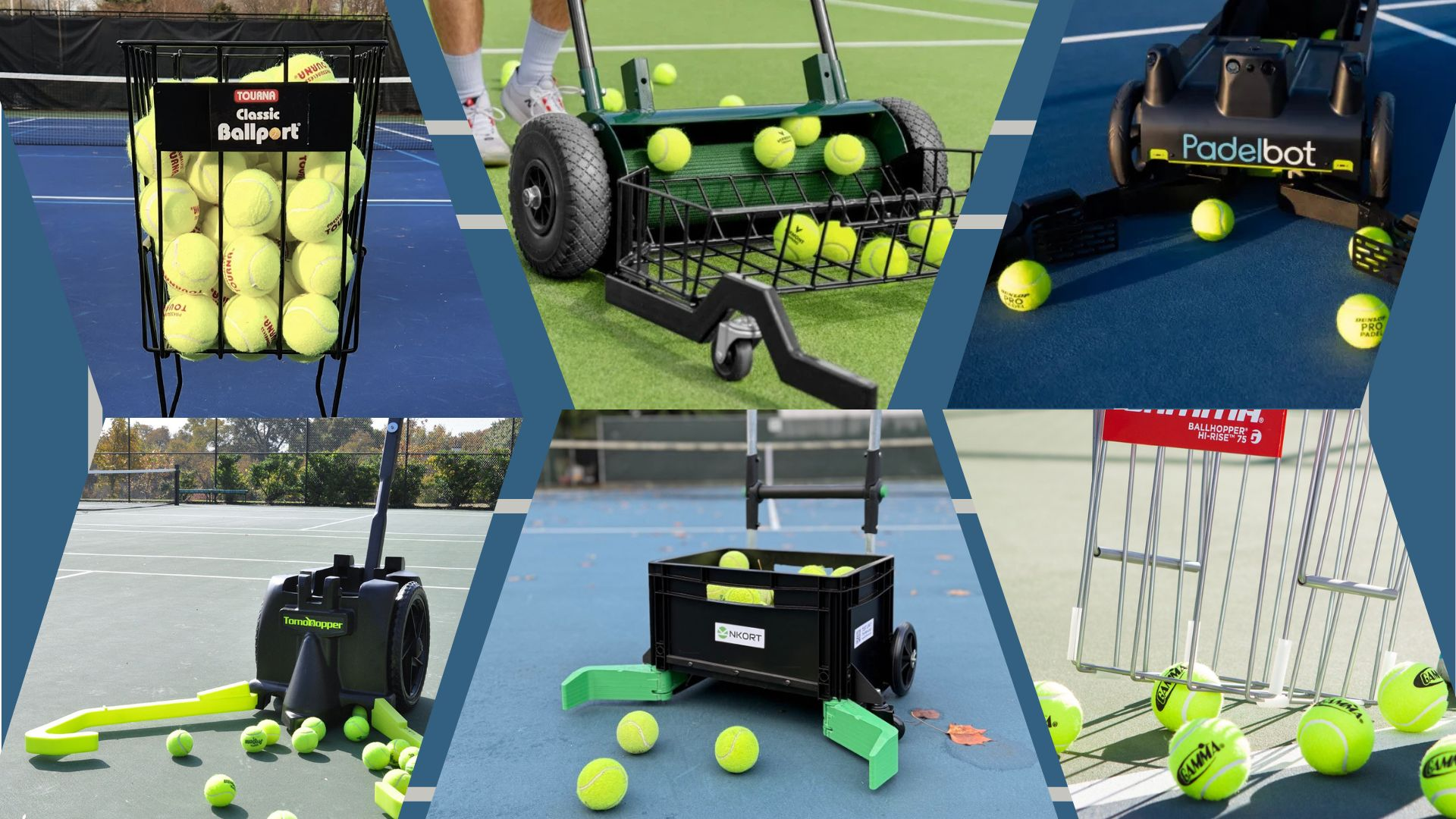
Category A: Classic hoppers and baskets (Tourna/Gamma style)
These are the familiar wire baskets and plastic “ballport” style baskets.
Example: Tourna Ballport 80 (plastic basket) holds 80 balls and uses sliding bars to keep balls from spilling.
Example: Tourna Ballport Classic style baskets commonly come in 70-ball versions.
What they do well
- Affordable
- Simple
- Widely available
- Decent capacity for the price
What frustrates ball machine users
- You still bend a lot
- Fence and corner pickup is slow
- Unloading into a ball machine can be clumsy (it is not the core design goal)
Category B: Rolling “ball mower” style collectors (Tomohopper and similar)
These are wheeled collectors with wide arms that sweep balls up quickly.
Example: Tomohopper is marketed as a portable rolling ball mower and commonly listed with a 90-ball basket, with extra baskets available, and arms spreading about 42 inches.
Example: Vermont Tennis Ball Collector Mower lists a 120-ball capacity basket.
Example: Playmate Ball Mower is positioned for fast pickup and notes fold-in arms for getting through gates and tight areas, and it is marketed for use on clay courts.
What they do well
- Very fast in open court
- Great for coaches feeding lots of balls
- Higher capacity options
What frustrates ball machine users
- Can be bulky if you are solo and travel light
- “Tight to fence” pickup varies by design and technique
- Unloading into a ball machine can still take some finesse depending on how the basket dumps
Category C: Kollectaball systems (K-Court / CS60 / K-Hopper)
Kollectaball sits in its own lane: a rolling collector that uses wire “openers” and a dispensing mechanism.
Examples and common claims you will see:
- K-Court is commonly described as holding up to 60 tennis balls, and using a V-Opener for dispensing into a hopper/cart/ball machine.
- K-Hopper (V2) is described as collecting up to 60 tennis balls, then flipping into a feeder, with adjustable feeding heights listed around 35–42 inches.
- CS60 is described by retailers as collecting 60 tennis balls and emptying quickly into storage or a ball machine.
What they do well
- Faster than classic baskets with less bending
- Designed with dispensing in mind, which helps ball machine workflows
- Portable compared to large mowers
What to watch
- Some players find certain edge cases (balls pinned tight to fence/corners) still require manual help depending on court layout and how you approach the fence line
- Like any mechanism, technique matters. If you use it incorrectly, performance drops fast
Category D: Robotic ball collectors (the “ball mower of the future”)
If your goal is “I want to hit and never pick up,” robots are the endgame.
Example: Tennibot Tennis Ball Retrieval System is listed by retailers with specs like 80-ball capacity, around 25 lb, and autonomous collection using computer vision/AI (plus battery/charge details).
What they do well
- Minimal manual pickup
- Strong “time saver” if you do high-volume sessions
What to watch
- Price is in a different universe than manual collectors
- You are now maintaining a robot (battery, sensors, storage, support)
Comparison table (focused on ball machine users)
This table is deliberately practical. It is not “who has the most features.” It is “who keeps your ball machine session flowing.”
| Category / Example brands | Typical capacity | Reload speed | Fence & corner pickup | Unloading into ball machine | Portability | Best for |
|---|---|---|---|---|---|---|
| Classic basket (Tourna Ballport, Gamma-style wire baskets) | ~70–120 | Medium to slow | Usually weak | Usually awkward | Excellent | Budget pick, occasional ball machine use |
| Rolling ball mower (Tomohopper, Vermont mower, Playmate Ball Mower) | ~90–120+ | Fast | Good in open court, varies tight to fence | Varies by basket design | Medium | Coaches, high-volume feeding, big drills |
| Kollectaball (K-Court, CS60, K-Hopper) | ~60 | Fast | Good, but can be situational in extreme tight spots | Strong emphasis on dispensing | Very good | Solo/coach hybrid, people who want speed + portability |
| Robot (Tennibot) | ~80 | Very fast (hands-off) | Good | Not relevant (it is the system) | Medium | Clubs, serious enthusiasts, “never pick up” lifestyle |
| FLIPP by NKORT | High (designed for ball machine workflows) | Fast | Excellent, especially hard-to-reach fence/corner areas | Designed to unload cleanly into a ball machine | Very good | Ball machine users who want the fastest manual reload loop |
Best picks by situation (so you do not overbuy)
If you are on a tight budget and use a ball machine occasionally
A classic basket is fine. A Tourna Ballport-style basket in the 70–80 ball range is a common “good enough” starting point.
Just accept that your reload pace will be the bottleneck.
If you run big drills, coach, or feed a lot of balls
A rolling ball mower format like Tomohopper (90-ball basket, wide arms) can be a massive time saver in open court pickup.
If you are on clay courts, products like the Playmate Ball Mower explicitly position themselves for that surface.
If you want fast collection plus easier dispensing into a machine
This is where Kollectaball tends to stand out. The K-Court is widely described as holding around 60 tennis balls and having a V-Opener designed to dispense into a hopper/cart/ball machine.
If you also like the idea of a built-in feeder height system, the K-Hopper is marketed as collector + feeder with adjustable height.
If your dream is “hit balls while something else cleans up”
Robots like Tennibot exist for a reason. They are a different investment category, but they are the closest thing to eliminating the pickup loop entirely.
Where FLIPP fits (and why ball machine users care)
Here is the honest issue with most solutions, even good ones:
The last few balls take the longest.
That last cluster near the fence. The ones in the corner. The ones trapped where your collector cannot get the angle it wants.
FLIPP by NKORT was built around that exact pain point. Its spring-loaded pickup mechanism is designed to excel in hard-to-get areas like fence lines and corners, and it can grab multiple balls in one motion. It is also designed to unload in a clean, controlled way into a ball machine, so you spend less time “managing the dump” and more time training.
If your sessions are built around repetition, FLIPP is aiming to be the fastest manual link in the “collect and reload” loop, not just another way to hold balls.
A quick buying checklist (print this mentally before you buy)
When you are comparing options, ask yourself:
- How many reload cycles do you do per session?
- Do you regularly end up with balls pinned near the fence?
- Do you need to unload directly into a ball machine hopper without spilling?
- Do you practice alone (portability matters more) or coach groups (capacity matters more)?
- What surface do you play on most (hard, clay, indoor)?
If you can answer those honestly, the “best” hopper usually becomes obvious.
Final thoughts (and a simple rule)
Ball machine practice is supposed to feel like flow. When ball pickup becomes the dominant activity, you are paying time and energy for something that is not improving your strokes.
A classic basket gets you started.
A mower-style collector speeds up open-court cleanup.
Kollectaball-style systems prioritize faster pickup and cleaner dispensing.
Robots remove the problem at a premium.
FLIPP is designed to win the specific moments that ruin ball machine rhythm: tight spots, fast multi-ball pickup, and clean unloading.
If you want your ball machine sessions to feel smoother in 2026, and you are ready to upgrade the part of training everyone hates, pre-order FLIPP by NKORT here.