
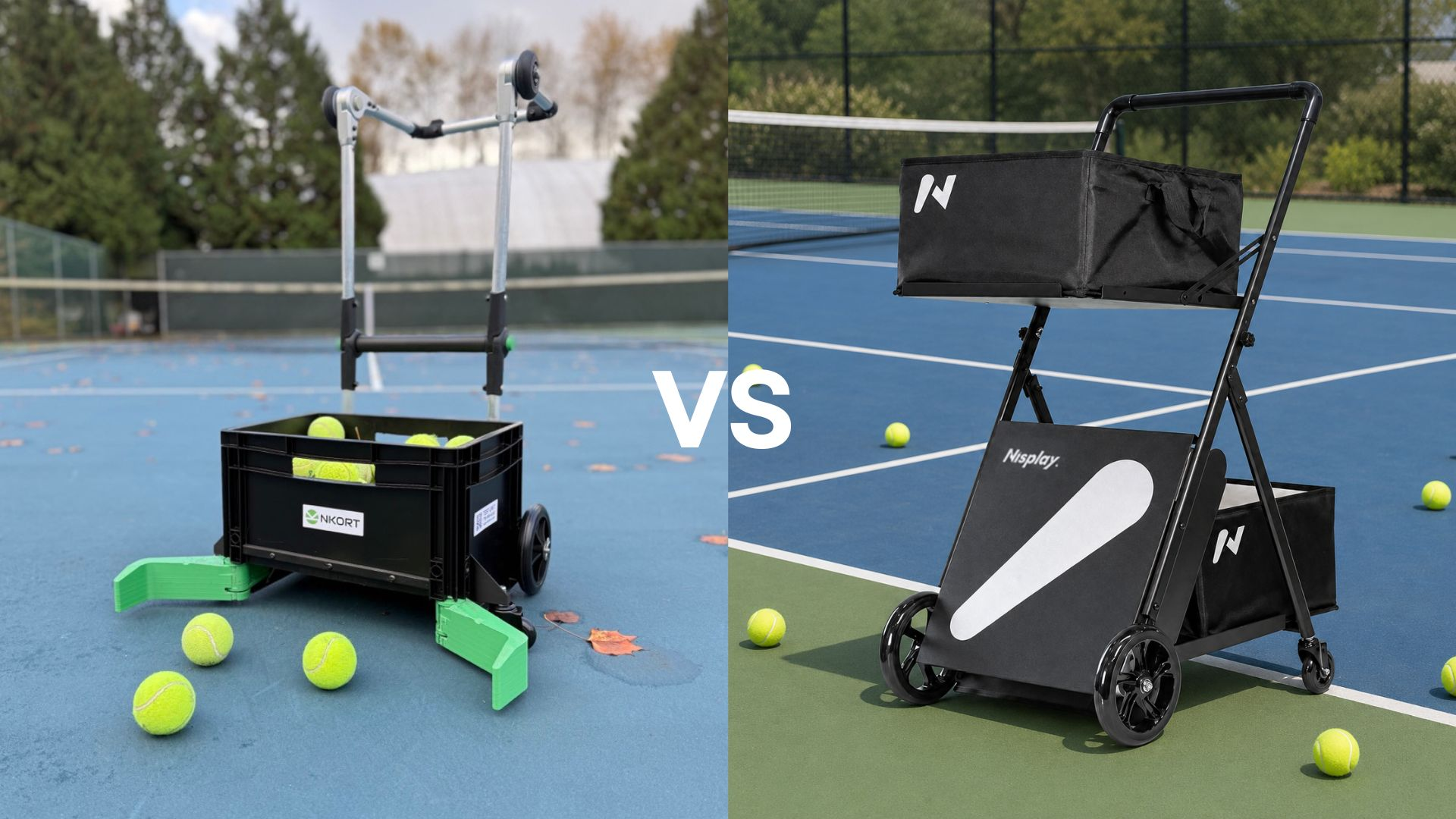
If you have seen the Nisplay Foldable Tennis Ball Cart, you may be wondering how it compares with FLIPP. Both products reduce bending and make collecting tennis balls faster, but they solve the problem in fundamentally different ways.
The simplest distinction is this:
Nisplay is a large-capacity court cart designed primarily for coaches and clubs. FLIPP is a compact, portable ball collector that transforms directly into an elevated hopper for players, families, and mobile coaches.
Neither approach is automatically better for everyone. The right choice depends on how many balls you use, where you store your equipment, whether you need to transport it regularly, and which racket sports you play.
Two different product philosophies
The Nisplay cart uses a mechanically driven conveyor system. As the user pushes the cart, balls are picked up from the floor and moved into a lower storage basket. A separate upper basket holds balls at a convenient feeding height. Nisplay lists a total capacity of up to 240 tennis balls, divided between the two levels.
That makes it well suited to academies, clubs, camps, and coaches running high-volume sessions. Nisplay itself describes the product as a tool for coaches, clubs, and frequent high-volume users—and acknowledges that a conventional hopper may be simpler for smaller sessions.
FLIPP was developed around a different objective: combine ball collection, transportation, storage, and an elevated practice hopper in the smallest practical product.
With FLIPP, the container that collects the balls is the same container that becomes the hopper. Rotate the handle, position the unit upright, and the collected balls are ready to use. There is no second basket and no need to transfer the balls from a lower collection compartment to a feeding basket.
That direct collect → flip → play workflow is the central difference between the two designs.
Side-by-side comparison
| Feature | FLIPP | Nisplay Ball Cart |
|---|---|---|
| Best suited for | Individual players, families, mobile coaches and smaller group sessions | Coaches, academies, clubs and high-volume sessions |
| Tennis-ball capacity | Approximately 100 | Up to 240 total, split between lower and upper baskets |
| Collection system | Spring-fork intake; press or roll FLIPP over the balls | Push-powered conveyor system |
| Hopper workflow | Collected container converts directly into an elevated hopper | Lower collection basket and separate upper feeding basket |
| Ball transfer | Not required | Required when moving collected balls from the lower section to the upper feeding basket |
| Fence and corner collection | Extendable spring-loaded forks help retrieve balls along edges, fences and corners | Wide cart and front conveyor require more approach and turning space |
| Sports | Tennis, pickleball, padel and compatible junior training balls | Marketed primarily for tennis balls |
| Approximate weight | 7 kg (15.4 lb) | 13 kg (28.7 lb) |
| Portability | Folding handle and compact enclosed body | Folding aluminum cart, but substantially larger and heavier |
| Listed price at time of writing | $299 USD | Approximately $429 sale price / $479 regular price |
| Power required | None | None |
Specifications and prices can change, so buyers should confirm current details on the respective product pages before ordering.
Where the Nisplay cart has the advantage
The Nisplay cart’s biggest advantage is capacity. A coach using 150 to 240 tennis balls during group clinics may prefer a large cart that stays beside the court. Its upper basket also remains permanently at feeding height, so the coach can feed balls without converting the unit.
Its conveyor architecture may also be efficient when collecting a large number of balls scattered across open areas of a court. A user can push continuously through a field of balls rather than positioning a collector over each small group.
For an academy with court-side storage, a large vehicle, and no stairs or frequent carrying, Nisplay’s additional size and weight may not matter very much. In that environment, capacity may be more valuable than portability.
That is the use case in which Nisplay makes the most sense.
Where FLIPP has the advantage
1. One container from pickup to practice
FLIPP does not merely combine a collector and a cart. It transforms the collection container itself into the elevated hopper.
The distinction matters in everyday use. With a dual-basket cart, balls collected at ground level eventually need to be moved to the upper feeding basket. With FLIPP, the balls stay in the same container throughout collection, transportation, and feeding.
That means fewer steps, fewer components, and less handling between drills.
2. Better access along fences and in corners
Balls rarely remain conveniently arranged in the middle of a court. They roll against fences, settle beside walls, and collect in corners—the places where large carts are hardest to maneuver.
FLIPP includes integrated, spring-loaded collection forks that extend the pickup area and help reach balls along court edges. The forks can be positioned close to a fence or into a corner, guide the balls toward the intake, and then snap back into place when they are no longer needed.
A wide conveyor cart needs enough room to approach a ball and continue rolling forward. Its frame and wheels also limit how closely the collection mechanism can follow a fence or turn into a tight corner. FLIPP’s narrower body and extendable forks are designed specifically for those awkward final balls that other collection systems often leave behind.
We have not yet published a controlled, side-by-side fence test against this particular Nisplay model, so this comparison is based on the geometry and intended operation of the two systems—not a claim about a timed head-to-head trial.
3. Portability that changes who can use it
“Foldable” and “portable” are not the same thing.
The Nisplay cart folds, but it still weighs approximately 13 kg. FLIPP weighs approximately 7 kg—about 46% less—and folds into a compact format designed to move from home to car to court.
That difference becomes important for anyone who:
- drives a smaller car;
- stores equipment in an apartment or garage;
- needs to carry it upstairs;
- moves between several teaching locations;
- shares public courts; or
- cannot leave equipment at a club.
FLIPP was not designed to win a capacity contest with commercial court equipment. It was designed to deliver serious ball collection without commercial-equipment bulk.
4. More than tennis
The Nisplay cart is marketed as a tennis-ball product. FLIPP’s patent-pending intake system was developed to collect balls of different diameters, including tennis, pickleball, padel, and compatible soft junior training balls.
For households, coaches, recreation centres, and clubs serving more than one racket sport, one versatile collector can be considerably more useful than a tennis-only cart.
5. A more accessible price
At the time of writing, FLIPP is offered at $299 USD. The Nisplay cart has been advertised at approximately $429 on sale and $479 at regular price.
The price difference reflects the products’ different architectures and target users. Nisplay offers more total capacity, while FLIPP prioritizes compactness, conversion, versatility, and ease of transport.
For a club buying stationary high-volume equipment, the additional cost may be justified. For an individual player, family, ball-machine owner, or mobile coach, FLIPP is likely the more practical investment.
A product with a visible inventor and origin story
There is another difference that does not appear on a specification sheet: buyers can see who created FLIPP, why it was created, and how it has evolved.
FLIPP was invented by Miguel Hernandez after he began playing tennis in his mid-forties and became frustrated with the available choices: slow wire hoppers and tubes at one end of the market, and large, expensive ball mowers at the other. Drawing on his mechanical-engineering background, Miguel began developing a product that could collect approximately 100 balls, transport them, and become an elevated hopper while remaining compact enough for ordinary players to carry and store.

The prototypes, tests, design changes, factory work, and manufacturing challenges have been shared publicly. Customers are not simply buying an object with a logo attached; they know the person responsible for the idea and can follow the work behind it. Read the FLIPP origin story
Nisplay states that it was founded in 2021 by “a team of passionate tennis players and technology innovators.” However, its public About page does not name an individual founder or identify the person who originated this particular cart design.
That does not mean Nisplay is not a legitimate company, and it should not be interpreted as evidence of wrongdoing. It simply means FLIPP offers a more personal and transparent founder story—an important distinction for customers who want to know who stands behind a new product.
What do the reviews tell us?
The Nisplay cart appears to be a relatively new product, and meaningful independent, long-term reviews remain limited at the time of writing. Third-party marketplace pages list little or no editorial coverage of this specific model.
That does not mean the cart performs poorly. It means buyers should distinguish product-page testimonials from independent evidence and should ask practical questions about:
- conveyor jamming;
- belt stretching or derailment;
- pickup performance with worn or wet balls;
- use on clay and synthetic surfaces;
- maneuverability beside fences;
- folding-joint durability; and
- availability of replacement parts.
Those are the issues that only real-world, long-term use can answer.
Which one should you choose?
Choose the Nisplay Foldable Tennis Ball Cart if you regularly use 150 to 240 tennis balls, run large clinics, have convenient storage, and value maximum capacity more than portability.
Choose FLIPP if you want a compact all-in-one collector and hopper, use approximately 100 tennis balls or 75 pickleballs, need to retrieve balls near fences and corners, play more than one racket sport, or regularly transport your equipment between home and the court.
The products overlap, but they are not direct substitutes for every user:
- Nisplay stores more.
- FLIPP goes more places, reaches more of the court, supports more sports, and removes the transfer between collection and feeding.
For clubs and academies running very large sessions, Nisplay’s capacity is a genuine advantage. For the much broader group of players, families, mobile coaches, and ball-machine owners who want professional ball collection without a large commercial cart, FLIPP provides the more portable and versatile solution.