
This past weekend, I had one of those rare moments that made nearly four years of work feel real.
I was at the Burnaby Tennis Open Festival at Burnaby Tennis Club, after a week of tournament play, clinics, games, families, juniors, volunteers, competitors, and people simply enjoying tennis. It was the kind of community event that reminds you why sports matter—not just because of performance or competition, but because they bring people together around something difficult, beautiful, and fun.
For me, the weekend had already been meaningful before the festival even started.
I entered my first real tennis competition at the 3.0 level. I am in my late 40s, and I had never competed before, so I’ll admit it: I was nervous. Not terrified, but definitely self-conscious. I was worried about my serve. I was worried about double faults. I was curious whether the tennis I had built in practice would survive the pressure of an actual match.
But that was exactly why I wanted to do it.
I didn’t enter with the expectation of winning. I entered to gather information. How would I behave under pressure? Would I tighten up? Would I enjoy it? Would I still be able to play the game I love when the score mattered?
The match turned out to be a great experience.
I lost the first set 4–6, won the second 6–4, and then lost the 10-point tiebreaker 10–3. My opponent was also playing his first tournament, and he was a great guy—friendly, respectful, and probably even more nervous than I was. He had clearly spent a lot of time working on his serve, and that made the difference. I made too many double faults, especially in the tiebreaker, where I think I started trying a little too hard.
But strangely, the loss did not bother me much.
The bigger result was internal: I competed. I held up. I belonged there. I could play a real match, feel the pressure, deal with the nerves, and still enjoy the experience.
For someone who has always loved tennis more as a craft than as a contest, that meant a lot.

But the most meaningful moment of the weekend came the next day.
The Burnaby Tennis Festival had clinics, activities, one-on-one games, and a fast serve challenge. Earlier, I had asked one of the organizers if it would be okay to bring FLIPP for people to test. He remembered seeing an early prototype last year and said yes, especially because there would be a lot of balls to collect during the kids’ activities and the serving challenge.
Still, I hesitated.
This is something I don’t think people always understand about building a physical product. Even after years of designing, prototyping, testing, improving, and refining, there is still a vulnerability in bringing your product into the real world. You worry people will misunderstand it. You worry they will dismiss it too quickly. You worry you will come across as someone trying to sell something instead of simply sharing something useful.
And with new products, context matters. If people test something without understanding what problem it is solving, or without comparing it to the tools they already use, they can miss the point entirely. But when they use it in the right situation, the value becomes obvious.
During the fast serve challenge, I noticed one of the volunteers, Brian, spending too much time collecting balls. People were serving from a large basket, balls were flying everywhere, and every few minutes everything had to stop so the balls could be gathered again.
So I finally decided to go back to my car and bring FLIPP.
I didn’t make an announcement. I didn’t explain what it was. I didn’t say I had designed it. I didn’t pitch anything.
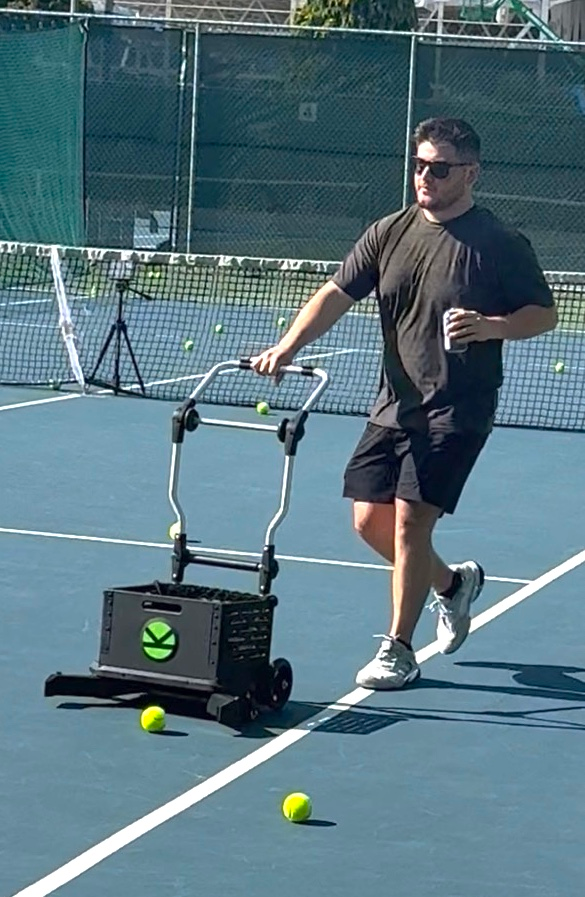
I just brought it onto the court in picker mode.
Brian immediately looked at it and said, “Thank you. Thank you so much.”
Then he started using it.
No instructions. No hesitation. No explanation.
He simply pushed it around the court with one hand, collecting balls quickly, while holding a drink in the other hand. It looked like he had been using it his entire life. When it was full, he asked how to empty it, then figured it out almost instantly: pick it up, tilt it, and dump the balls into the larger basket.

Then another volunteer used it the same way.
Again, no explanation needed.
That was the moment.
Not a dramatic moment. Not a loud one. Nobody stopped the event. Nobody gathered around asking technical questions. Nobody treated it like some strange invention.
In a way, that was what made it so satisfying.
FLIPP was just there, being useful.
It entered the flow of the event and did exactly what it was designed to do. It helped people collect balls faster, with less effort, so the activity could keep moving. The volunteers were happy. The players kept serving. The kids kept playing. The festival kept flowing.
After almost four years of development, that was deeply fulfilling to see.
Because at the end of the day, that is the real payoff of building something. You spend years solving problems, refining ideas, and chasing small improvements, hoping that one day the product will simply fit into people’s lives. Then one day it does. Someone picks it up, uses it without hesitation, and it quietly makes their job easier. That’s when all the work finally feels worth it.
That is what I saw this weekend.
And it made me incredibly happy.
FLIPP exists because ball pickup is one of those small, repetitive frustrations that every tennis, pickleball, and padel player understands. It interrupts practice. It slows down drills. It eats into the time people actually want to spend improving. My hope has always been simple: help players, coaches, clubs, and families spend less time collecting balls and more time playing.
This weekend, I got to see that happen in the real world.
Not as a pitch. Not as a demo. Not as a sales moment.
Just as a small, useful tool doing its job.
And for me, as the person who has carried this idea through years of uncertainty, iteration, doubt, and persistence, that was more satisfying than I can properly explain.
I left the festival feeling grateful: grateful to the organizers and volunteers, grateful to the Burnaby tennis community, grateful to the people who keep showing up to learn and compete, and grateful that something I built could play even a tiny role in making the day run better.
That is why I wanted to share this.
Because sometimes the biggest milestones in building a product are not the loud ones.
Sometimes they are quiet.
Sometimes they look like a volunteer pushing your invention across a tennis court, collecting balls with one hand, without needing a single explanation.
And sometimes, that is enough to make the whole journey feel worth it.
Miguel @ NKORT
P.S: My fastest serve was 127 kph (79 mph) and the fastest of the competition was 191 kph (118 mph) — My goal is to reach 100 mph without my arm flying out of its socket. Vamos!