
Hello dear FLIPP backers,
It’s probably been one of the busiest months of my life. During the first two weeks of May, my siblings and I had to travel to Spain (our home country) to attend the funeral of a close relative. It was nice to spend time together with family, although under very sad circumstances. It’s yet another reminder of how precious and short life is, and why we should do everything we can to enjoy our time and contribute positively to others.
Bringing FLIPP to life is one of the ways I hope to provide value back to society, especially to all the players and coaches who want to maximize efficiency during their training sessions.
Visiting the factory
Now onto the trip to China. Just five hours after a 14-hour flight from Spain back to Canada, my wife and I boarded another 14-hour direct flight from Vancouver to Shenzhen, where the FLIPP factory is located.
China has developed tremendously over the last two decades, and Shenzhen is now one of the most modern cities in the world. Not long ago, it was a small fishing village of around 30,000 inhabitants, and today it’s one of the most advanced and busiest manufacturing hubs on the planet.

I could write several pages about everything we experienced during those six days in China, but I know what most of you care about is when you’ll finally get your hands on your brand new FLIPP unit and start collecting balls like there’s no tomorrow.
So to summarize, the main goal of this trip was to meet the factory team in person and evaluate the first pre-production prototypes before committing to tooling and mass production.

Getting to most factories these days takes a bit longer because land prices have risen dramatically over the last few years. As a result, many factories are moving further inland, often one to two hours away from central Shenzhen. In my case, the engineering lead and project manager drove us to the factory, which was indeed about 1.5 hours north of our hotel.
Most medium-sized factories in China operate inside multi-story buildings to save on land costs. My factory actually owns several of these buildings, each specialized in different manufacturing processes such as plastics, metal fabrication, metal stamping, die-casting, and assembly.
The building we visited is where they mainly handle plastic injection molding and where most of the FLIPP parts will be manufactured and assembled. FLIPP also features an aluminum tube handle, which will be produced at their metal fabrication facility that we unfortunately didn’t get a chance to visit this time.

It was difficult for me to make a comparative assessment since I had never visited factories in China before. However, I did get the opportunity to tour two additional factories, and they were quite similar in layout and capabilities, which reassured me that our manufacturing partner is operating at a competitive level.
The factory building itself was only two years old. The company has been in business for roughly 25 years, but due to rising land costs, they’ve gradually relocated operations further inland away from the coast.
They gave me a full tour of all nine floors. The heaviest machinery is located on the lower floors, while the upper floors are reserved for quality assurance, office space, raw material storage, and assembly operations.
Their facilities were fairly clean, the factory was quite busy producing products for several very well-known brands, and the workers generally seemed happy and organized.

As for the team, they were extremely friendly, professional, and attentive. They even invited us to a very nice dinner where one of the factory owners (or “bosses” as they commonly say there) joined us and shared a lot of insight into how the manufacturing landscape has evolved over the past decade. Manufacturing in China has become significantly more expensive, and many factory owners are now opening facilities in Vietnam and India. However, the Chinese manufacturing ecosystem is still far more mature and efficient when it comes to producing high-quality goods at scale and in record time.
Testing the pre-production prototype
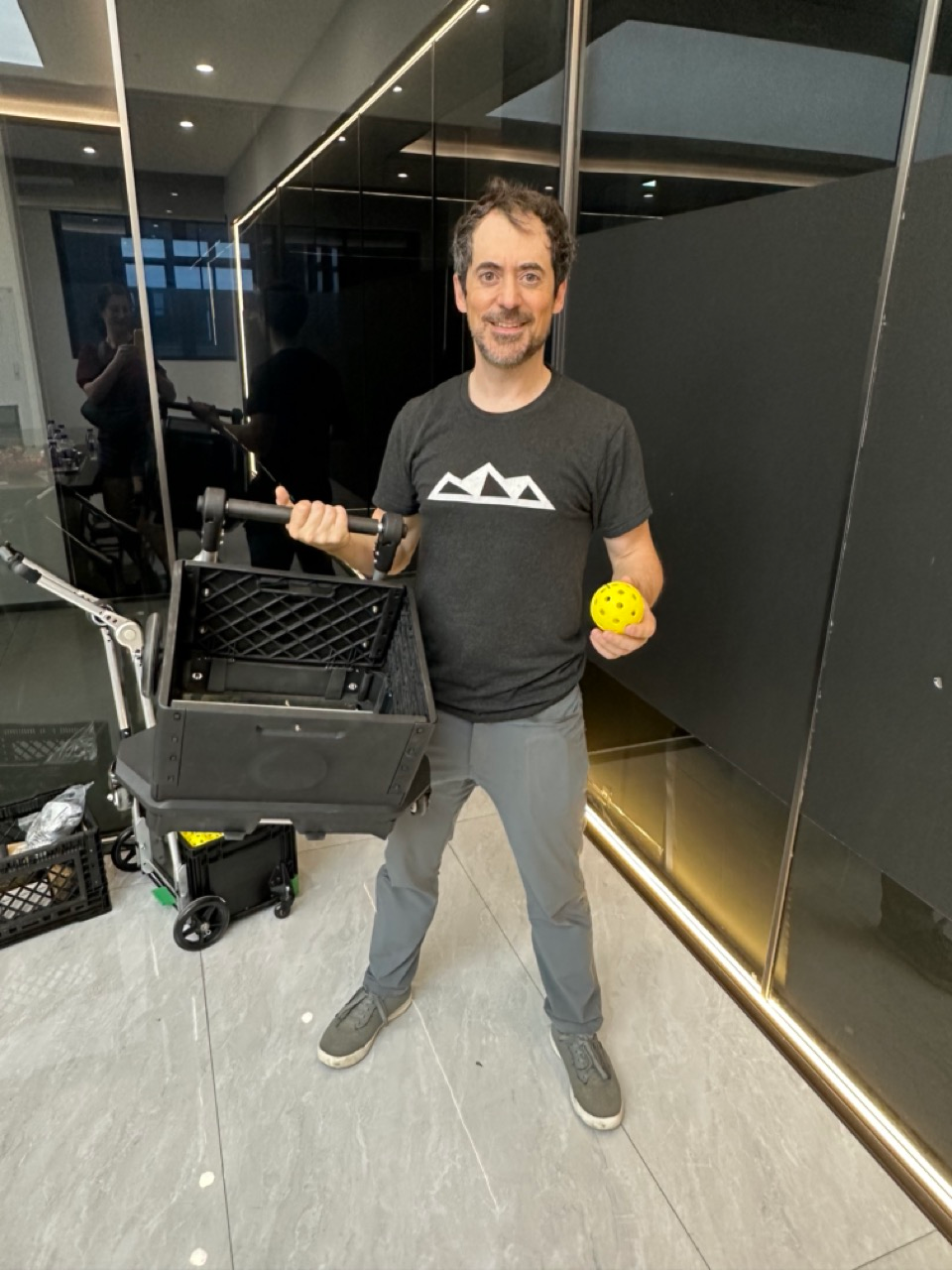
Right after the factory tour, we had the opportunity to review and test the first pre-production prototypes. They had built two versions: one made from resin material and another using 3D-printed nylon plastic. The resin sample was mainly intended to test dimensions and the ball-picking mechanism, while the nylon prototype is much closer to what the final production model will look like.

The nylon prototype worked largely as expected. The only drawback is that 3D-printed nylon does not have the same properties as final injection-molded plastic and tends to be considerably more flexible. This was only noticeable when testing the unit fully loaded with approximately 100 tennis balls. Pickleballs, being much lighter, did not generate any meaningful deflection.
To minimize flex on both the box and handle, especially in hopper mode, the engineering team agreed to strengthen the bottom structure of the ball receptacle, use thicker aluminum tubing for the handle/pedestal, and reinforce the handle joints. They explained that some level of deflection is unavoidable due to the cantilevered nature of the load in hopper configuration. As always, the challenge is balancing robustness, weight, and overall manufacturing cost.

At the moment, the cost per unit is already considerably higher than originally estimated, so we need to be very careful where additional costs are introduced. We can increase tubing thickness, for example, but if we go too far, both the total product weight and unit cost increase significantly as well.

The team also mentioned that aluminum prices have risen substantially in recent months. In addition, global geopolitical tensions (i.e.: Iran war) and shipping volatility continue to affect plastic costs, logistics, tariffs, and overall manufacturing expenses. In short, keeping production costs under control has become increasingly challenging in today’s environment.
Next steps
The next step is for the factory team to provide an updated 3D CAD model, revised bill of materials, and updated tooling quotation. They said they expect to have everything ready by June 2nd.
At that point, I would submit the tooling down payment so they can begin manufacturing the injection molds, which are expected to take around two months to complete.
They said the earliest production could begin would be early August, and they estimate manufacturing 1,500 units would take roughly three weeks. Interestingly, while I was there, they were producing around 1,000 units per day of a significantly more complex product, so once the FLIPP assembly line is fully ramped up, producing 1,000 FLIPPs per day should not be an issue.
That said, ramping up production itself takes time. They need to finalize the assembly workflow, train workers, establish quality control procedures, and optimize production efficiency. Even so, three weeks still sounds incredibly fast to me considering it took me close to a full month to build a single working prototype by hand!
So when will you get your FLIPP?
If everything goes according to plan, the first shipment from China would leave by freight ship near the end of September. Transit to the US warehouse would take approximately one month, followed by several additional days for fulfillment to individual US backers. The US warehouse will also handle international shipments, which account for roughly 15% of all pre-orders.
My very naive original estimate was to begin deliveries in late May. The reality is that, given the complexity of this product (approximately 62 unique parts, including several fairly complex plastic components), less than 12 months from early hand-built prototype to full mass production would already be considered extremely fast if everything goes according to plan.
This process certainly gives you a whole new appreciation for the everyday products we often take for granted. Behind every gadget you own are months, and often years, of development, engineering, logistics, setbacks, negotiations, and bureaucracy.
Sometimes I wonder why anyone would voluntarily embark on such a challenging endeavor. Probably some combination of ambition, naivety, obsession, and just a small touch of insanity sprinkled in for good measure!
Well, I hope you enjoyed this update. Thank you supporting FLIPP and for following along on this rollercoaster journey into the manufacturing world.
More to come soon… Vamos!
Miguel @ NKORT

Did you miss our Kickstarter launch?
You can still preoder FLIPP directly from our website.
4 responses to “Manufacturing Update 2026-05-26: Visiting The FLIPP Factory”
Thank you so much for taking the time to provide such a detailed account of your activities and progress on NKort!! I know you have much to do and your time is very limited. Kudos to you for embarking on this journey! I know the plethora of decisions and details can be overwhelming. I look forward to your finished project!
Thank you for your support JeanAnn!
As a coach, picking balls is my bugbear. I’m so excited for this. I love your passion for sport and undertaking this challenge on behalf of all the pickleball and tennis nuts out there!
Thank you Bharat!